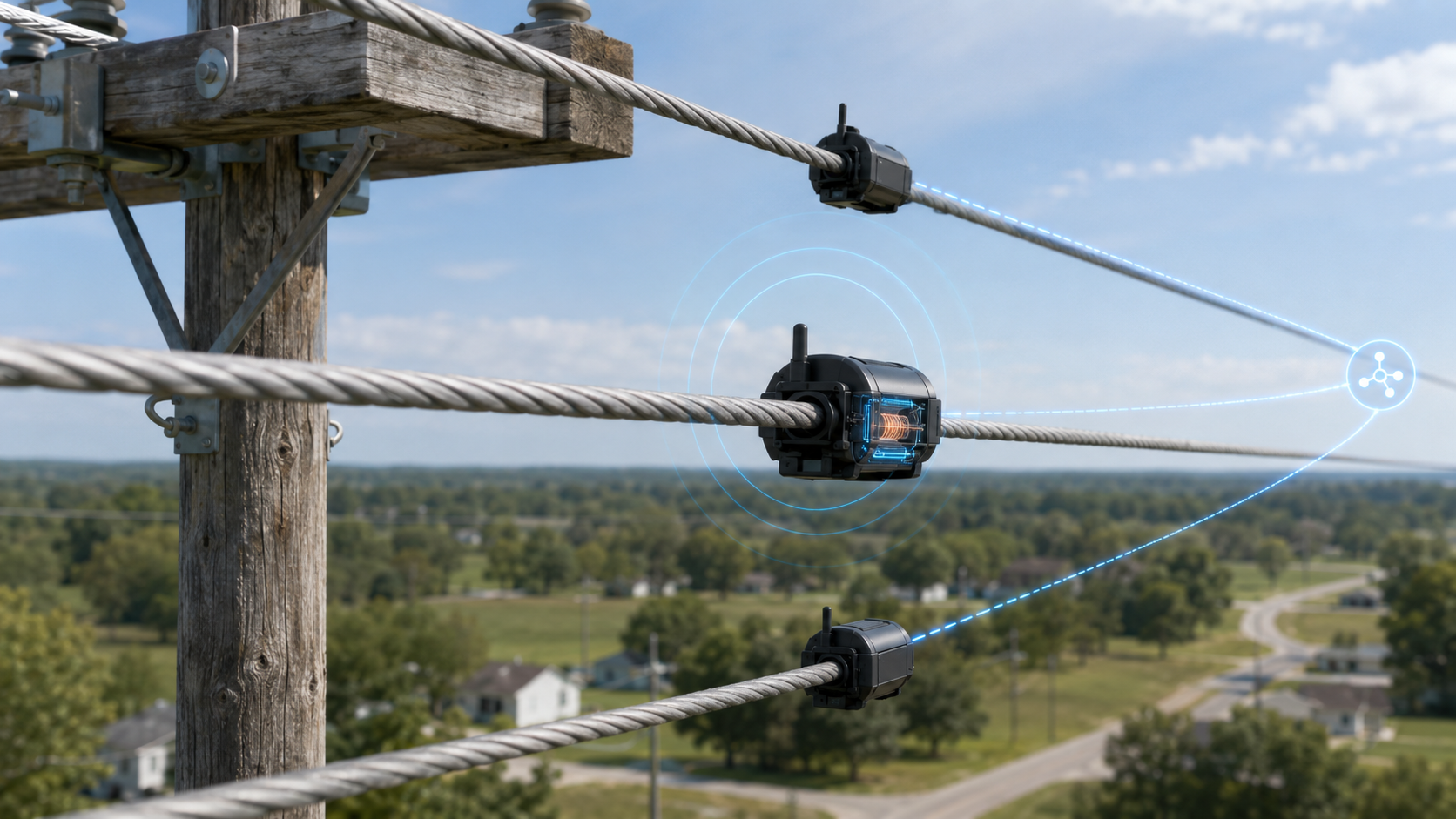
Overhead line fault indicators help utilities find the faulted section of a power line faster. They do not repair the fault, but they give operators and field crews clear information about where to start inspection and restoration work.
Quick Answer
An overhead line fault indicator is a device used on overhead distribution lines to detect and indicate fault conditions such as short circuits or earth faults. A line fault indicator may show the fault locally with a visible signal, send a remote alert, or do both. In many networks, it works as a line fault sensor by monitoring current and, in some designs, voltage-related conditions on the line.
Table of Contents
Why Overhead Lines Need Fault Indicators
Overhead distribution lines often cover long distances and pass through areas that are difficult to inspect quickly. A fault can be caused by lightning, vegetation contact, damaged insulation, broken conductors, animals, equipment failure, or external impact. When a feeder trips, the control center may know that there is an outage, but not always the exact section where the problem happened.
Without fault indication, crews may need to patrol many kilometers of line. This increases outage duration, repair costs, and customer dissatisfaction. Overhead line fault indicators reduce uncertainty by showing whether fault current has passed through a specific point on the feeder.
Key Point
The main value of a fault indicator is faster fault location. It helps utilities narrow the search area, dispatch crews more accurately, and restore service faster after protection equipment has isolated the fault.
What Fault Indicators Detect
Most overhead line fault indicators are designed to detect abnormal electrical conditions associated with faults. The exact functions depend on the device design, network grounding method, and protection philosophy.
Short-Circuit Faults
A sudden high current can indicate a phase-to-phase or three-phase fault. The indicator detects the abnormal current rise and changes its state.
Earth Faults
In many networks, an earth fault is detected through current imbalance or zero-sequence current behavior. Sensitivity depends on the grounding system.
Voltage Loss or Restoration
Some devices can recognize whether the line is energized or de-energized. This helps with resetting and with separating real faults from temporary current changes.
Fault Passage
A line fault indicator may not calculate an exact distance. Instead, it confirms that a fault has passed through its installation point.
How Overhead Line Fault Indicators Work
The working principle is easier to understand if you look at the sequence of events during a fault. A fault indicator is normally installed at selected points along a feeder, such as after a substation, near branches, or close to sectionalizing devices.
Normal current flows through the conductor
During normal operation, current flows within expected limits. The fault indicator monitors the line and remains in its normal state. In many designs, the sensor uses the magnetic field created by current flow around the conductor.
A fault creates abnormal electrical conditions
When a short circuit or earth fault occurs, current and voltage conditions change. The fault may cause a sharp increase in current, an imbalance between phases, or a voltage loss after the feeder protection trips.
The line fault sensor recognizes the event
The device compares the detected conditions with its settings or internal logic. If the event matches the fault criteria, the sensor registers a fault passage.
The indicator changes state
The device may activate a visible flag, LED, flashing light, or remote signal. This tells crews or operators that the fault current passed that location.
Operators use several indicators to find the faulted section
If indicators upstream of a location are triggered and downstream indicators are not, the fault is likely between those points. This helps reduce the search zone and improves crew dispatch.
Main Types of Overhead Line Fault Indicators
Fault indicators can be grouped by how they are installed and how they communicate fault information. The right type depends on the network design, line voltage, available communication channels, and utility operating practices.
| Type | How it works | Best suited for |
|---|---|---|
| Visual fault indicator | Shows a local signal such as a flag or LED after a fault event. | Field patrols, simple feeder sections, areas with limited communication coverage. |
| Remote fault indicator | Sends fault information to a control center or monitoring system. | Long feeders, rural networks, automated distribution systems, faster dispatch workflows. |
| Directional fault indicator | Helps determine the direction of the fault relative to the installation point. | Networks with multiple sources, looped feeders, distributed generation, and complex switching schemes. |
| Conductor-mounted line fault sensor | Installed directly on or near the overhead conductor to monitor line conditions. | Overhead distribution lines where segment-level visibility is needed. |
Where Fault Indicators Are Installed
Correct placement is just as important as the device itself. A fault indicator should be installed where its signal helps operators divide the feeder into useful sections.
Common installation points include:
- main feeder sections after the substation;
- important branches and laterals;
- sections with frequent faults;
- remote or hard-to-access line segments;
- areas with dense vegetation or severe weather exposure;
- locations near sectionalizers, reclosers, or switching devices;
- critical supply lines for industrial, public, or high-priority customers.
The goal is not to install indicators everywhere. The goal is to create useful fault location zones. Each device should help answer a practical question: did the fault pass this point or not?
Benefits for Utilities and Field Crews
Overhead line fault indicators support both control room operations and field work. They provide a simple but important layer of visibility between the substation and the end of the feeder.
Faster fault location
Crews can avoid inspecting the entire line and focus on the section most likely to contain the fault. This is especially valuable on long overhead feeders.
More accurate crew dispatch
When operators know the probable faulted section, they can send the right crew to the right area with better instructions and fewer unnecessary truck rolls.
Reduced outage duration
Fault indicators do not prevent every outage, but they can reduce the time needed to locate and repair faults. This can support better reliability performance and customer service.
Better network automation
Remote fault indication can be integrated with SCADA, outage management systems, and distribution management systems. This supports faster decisions during fault location, isolation, and service restoration.
Limitations and Selection Factors
A line fault indicator is a support device, not a complete protection system. It should be coordinated with relays, breakers, reclosers, fuses, grounding configuration, and the utility’s operating procedures.
Important Limitation
A fault indicator usually shows that a fault has passed through a point. It does not always identify the exact physical cause of the fault. Crews still need to inspect and repair the line.
Before selecting a fault indicator, utilities should consider:
- voltage level of the overhead line;
- expected load current and fault current levels;
- network grounding method;
- need for short-circuit, earth fault, or directional detection;
- local visual indication versus remote reporting;
- communication method and coverage;
- reset method after fault clearance or line re-energization;
- environmental conditions such as temperature, ice, wind, and humidity;
- compatibility with existing SCADA, OMS, or DMS platforms.
Practical Example: How Indicators Narrow the Search Area
Imagine a long overhead feeder with three line fault indicators installed along the route. After a fault occurs, the first and second indicators show a fault passage, but the third indicator remains normal. This suggests that the fault is likely between the second and third indicators.
Instead of sending a crew to inspect the entire feeder, the dispatcher can direct the crew to that specific section. If the network also has remote indication, this decision can be made before anyone reaches the line.
This example shows why fault indicators are useful: they convert a large search area into a smaller, more manageable inspection zone.
FAQ
Is a fault indicator the same as a protection relay?
No. A protection relay detects fault conditions and sends a trip command to interrupt power through a breaker or recloser. A fault indicator mainly provides information about fault passage or location. It supports operations but usually does not interrupt the circuit by itself.
Can overhead line fault indicators detect every fault?
No device can detect every fault under every network condition. Detection depends on fault type, fault current level, grounding method, device settings, and line configuration. High-impedance faults and compensated networks can require more advanced detection logic.
Do fault indicators reduce outage time?
They can help reduce outage time by making fault location faster. The actual result depends on installation coverage, communication, crew availability, switching options, and repair conditions.
What is the difference between a line fault sensor and a line fault indicator?
The terms are often used close to each other. A line fault sensor emphasizes the sensing function: monitoring current, voltage, or fault-related conditions. A line fault indicator emphasizes the output: showing or reporting that a fault has occurred.
Conclusion
Overhead line fault indicators are practical devices that help utilities detect and locate faults on overhead distribution lines. They monitor electrical conditions, recognize fault events, and provide local or remote indication to operators and field crews.
Their main value is not in replacing protection systems, but in improving visibility. A well-placed line fault indicator or line fault sensor can reduce manual patrol time, support faster crew dispatch, and help restore power more efficiently.
For utilities managing long or hard-to-access overhead lines, fault indicators are a useful step toward more reliable and better automated distribution networks.
Need better visibility on overhead lines? Use fault indication and line monitoring to reduce search time, improve dispatch accuracy, and support faster restoration workflows.
Learn more about overhead line fault indicators