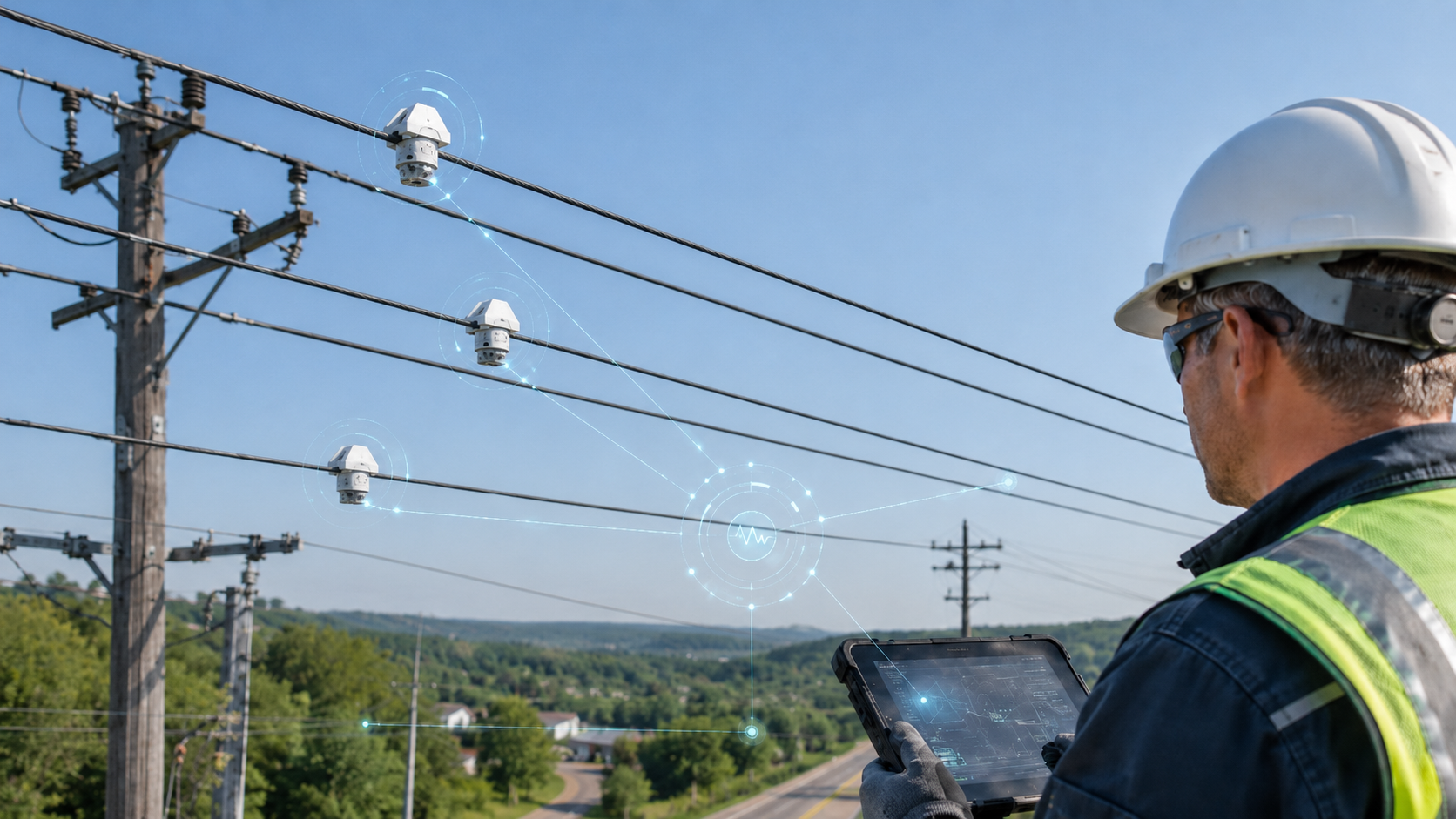
The Role of Line Sensors in Distribution Network Automation
Distribution networks are changing. Utilities now need to manage growing energy demand, distributed generation, aging infrastructure, and higher expectations for power reliability. At the same time, many overhead power lines still run through remote areas, forests, fields, industrial zones, and other locations where fault inspection can take a long time.
This is where line sensors become important. They help utilities see what is happening on the network, detect abnormal conditions, and respond faster when a fault occurs. In distribution network automation, line sensors are not just additional devices on the line. They are a practical source of field data that helps operators make faster and better decisions.
Key Point
Line sensors do not prevent every power line fault. Their main value is faster fault detection, better feeder visibility, improved crew dispatch, and shorter restoration time after an outage.
What Are Line Sensors?
Line sensors are devices installed on overhead or underground power lines to monitor electrical conditions. Depending on the application, they can detect fault current, load current, voltage presence or loss, short circuits, earth faults, and other abnormal events.
In overhead line applications, line sensors are often mounted directly on the conductor or installed near the line. Some devices provide a local visual signal, such as an LED indication. More advanced systems can also send remote alerts to a control center, SCADA system, outage management system, or distribution management platform.
The main purpose is simple: when something happens on the line, the utility receives useful information faster. This makes line sensors an important part of overhead line monitoring, fault passage indication, and modern feeder automation.
Why Distribution Automation Needs Field Data
Distribution automation depends on accurate information from the field. Automated switches, reclosers, control systems, and software platforms can only work effectively when they receive reliable data about the real condition of the network.
Without line sensors, operators often know that a feeder has tripped, but they may not know exactly where the fault occurred. Crews may need to inspect long sections of the line before finding the damaged area. This is slow, especially during storms, at night, or in hard-to-reach locations.
Line sensors help reduce this uncertainty. They show whether a fault has passed through a specific point on the feeder. As a result, operators can narrow the search area and send repair crews to the most likely faulted section.
Better Visibility
Operators receive more information from the feeder instead of relying only on customer calls or delayed field reports.
Faster Response
Fault data helps dispatchers send crews to the right area sooner and reduce time spent on manual line patrols.
Smarter Automation
Sensor data supports SCADA, outage management, and distribution management systems with real field events.
Fault Detection and Fault Location
One of the most important roles of line sensors is fault detection. When a short circuit or earth fault occurs, the sensor detects abnormal electrical conditions and records or signals the event.
This information helps operators understand the direction and approximate location of the fault. If sensors are installed at several points along a feeder, the utility can identify the section where the fault is likely located. This is much faster than sending crews to inspect the entire line.
What line sensors help reduce
- outage duration;
- manual line patrols;
- unnecessary truck rolls;
- restoration time;
- operational costs;
- customer complaints.
Line sensors do not replace protection devices such as circuit breakers or reclosers. Instead, they support them by adding better visibility and faster fault information.
Local Indication and Remote Monitoring
Line sensors can provide information in two main ways: local indication and remote monitoring.
Local indication
Local indication is useful for field crews. If a sensor shows that a fault has passed through a specific point, the crew can confirm that they are moving in the right direction. This is especially helpful during physical line inspection.
Remote monitoring
Remote monitoring is even more valuable for distribution network automation. With remote communication, fault information can be sent directly to the control center. Operators can receive alerts, check the affected feeder, compare information from several points, and decide what action should be taken next.
Remote fault indication is especially useful for rural and long overhead lines, where physical inspection may take hours. It helps utilities move from reactive field patrols to faster, data-based response.
| Approach | Main purpose | Best use case |
|---|---|---|
| Local visual indication | Shows fault passage directly on the line | Field inspection and crew confirmation |
| Remote fault monitoring | Sends fault alerts to a control center or software system | Automated networks, rural feeders, and faster dispatch |
| Combined indication | Provides both field visibility and remote data | Networks that need both crew support and real-time control room awareness |
Integration with SCADA, OMS, and DMS
For line sensors to create the highest value, they should be connected to wider grid management systems.
SCADA integration
SCADA systems help operators monitor and control electrical equipment in real time. When line sensor data is available in SCADA, the control center can see fault events and network status more clearly.
Outage management systems
Outage management systems help utilities manage power interruptions, estimate affected areas, dispatch crews, and communicate restoration progress. Line sensor data can improve outage location and support better crew coordination.
Distribution management systems
Distribution management systems combine network data, switching plans, feeder models, and real-time information. When line sensors are integrated into such systems, they can support more advanced automation functions, including fault location, isolation, and service restoration.
Practical Value
The more complete the field data is, the more accurately operators can understand what is happening on the network. This helps reduce guesswork during outage response.
Supporting FLISR
FLISR stands for Fault Location, Isolation, and Service Restoration. It is one of the key functions of modern distribution automation.
The process usually includes three steps:
- Fault location — identifying the section where the fault occurred.
- Isolation — separating the damaged section from the healthy part of the network.
- Service restoration — restoring power to customers who can be safely reconnected.
Line sensors support the first step by giving information about fault passage and network condition. When this data is combined with automated switches or reclosers, the utility can make faster decisions about which section should be isolated and which customers can be restored.
In some networks, this process is supported by software. In others, operators still make the final decision manually. In both cases, line sensors provide important information that improves the quality and speed of the response.
Reducing Outage Duration
Line sensors are often connected with reliability improvement because they help reduce the time needed to find and manage faults.
They do not eliminate all faults. Weather, vegetation, lightning, equipment wear, animals, and external damage can still cause interruptions. However, line sensors help utilities respond more efficiently after a fault has occurred.
This can have a positive impact on outage-related reliability indicators, especially those connected with restoration time. When the faulted section is found faster, repair crews can begin work sooner. When healthy sections are restored faster, fewer customers remain without power for a long period.
For customers, this means shorter interruptions. For utilities, it means better operational efficiency and more predictable outage management.
Improving Crew Dispatch
Crew dispatch is one of the most practical areas where line sensors provide value.
In a traditional process, dispatchers may send crews to inspect a wide area. The crew may need to drive along the feeder, check poles, inspect conductors, and look for visible damage. This can be slow and expensive.
With line sensor data, dispatchers can narrow the search zone before the crew leaves. They can send the team closer to the suspected fault location and provide clearer instructions.
This helps utilities
- reduce travel and inspection time;
- avoid sending crews to the wrong section;
- improve safety planning;
- prepare the right tools and equipment;
- restore service faster.
For long overhead lines and remote feeders, this can make a significant difference.
Role in Smart Grid Development
A smart grid needs data from the field. Sensors, communication systems, automation devices, and software platforms work together to create better network visibility and control.
Line sensors are one of the practical building blocks of this approach. They give operators information about feeder conditions, fault events, load flow, and line status. This helps utilities move from manual inspection to more automated and data-driven operations.
As distribution networks become more complex, this visibility becomes even more important. Distributed energy resources, changing load patterns, and higher reliability expectations all require better monitoring at the feeder level.
Line sensors help utilities understand the network not only at the substation, but also along the line itself.
Where Line Sensors Are Most Useful
Line sensors can be useful in many parts of a distribution network, but they are especially valuable in areas where fault location is difficult or time-consuming.
Long Overhead Feeders
Useful where crews may otherwise need to inspect many kilometers of line before finding the faulted section.
Remote Areas
Helpful for rural, forest, mountain, and hard-to-access locations where travel time increases outage duration.
Automated Networks
Important where SCADA, DMS, reclosers, or automated switches depend on field data for faster decisions.
They can also be useful at important branching points, near switching devices, or at boundaries between network sections.
What to Consider When Choosing Line Sensors
Before selecting line sensors for distribution automation, utilities should evaluate both technical and operational requirements.
| Selection factor | Why it matters |
|---|---|
| Voltage level | The sensor must be suitable for the network class and installation environment. |
| Fault detection requirements | Different networks may require short-circuit detection, earth fault detection, or both. |
| Installation conditions | Overhead, underground, rural, and harsh-weather applications may need different device designs. |
| Communication options | Remote monitoring depends on reliable communication coverage and compatible protocols. |
| System compatibility | Data should be usable by SCADA, OMS, DMS, RTU, or other utility platforms. |
| Maintenance approach | Utilities should consider service life, inspection needs, battery strategy, and reset method. |
The best solution depends on the network design and the operational goals. A simple visual fault indicator may be enough for some lines. A remotely monitored line sensor may be more suitable for critical feeders, long rural lines, or automated networks.
Need Better Visibility on Overhead Lines?
Explore how overhead line fault indicators and sensors can support faster fault detection, remote monitoring, and more efficient feeder operation.
View overhead line fault indicators and sensorsConclusion
Line sensors play an important role in distribution network automation. They help utilities detect faults faster, locate the affected section more accurately, reduce manual patrols, improve crew dispatch, and support faster service restoration.
Their main value is visibility. When operators receive timely information from the field, they can make better decisions and restore power more efficiently.
For modern distribution networks, line sensors are not just monitoring devices. They are part of a wider move toward smarter, more reliable, and more automated power distribution.