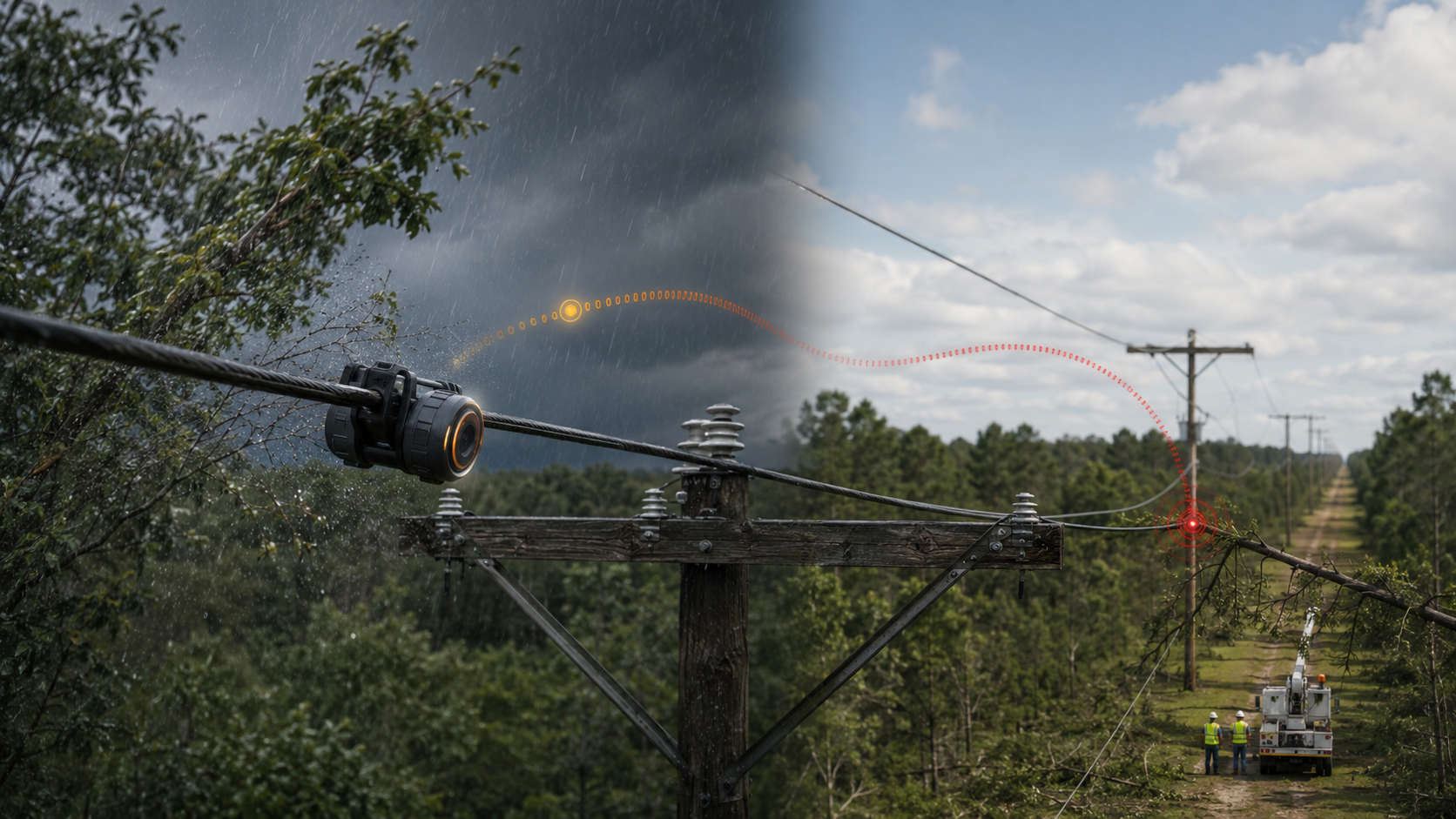
Overhead lines are exposed to weather, vegetation, wildlife, and mechanical damage. Fault indicators help operators understand what happened on the feeder and decide whether the event is likely temporary, needs monitoring, or requires a repair crew.
Quick Answer
A temporary fault can disappear after the circuit is opened and re-energized. A permanent fault remains until the damaged equipment or line section is repaired. Overhead line fault indicators, including a line fault sensor or line fault indicator, help utilities detect where fault current passed, confirm the likely faulted section, and support faster decisions after protection devices operate.
Why the Difference Matters
For a utility control center, not every fault should be treated the same way. Some faults are short-lived and clear after a recloser or circuit breaker opens the circuit. Others are caused by broken conductors, damaged insulators, fallen trees, or failed equipment and require field repair.
If operators cannot quickly understand the likely nature and location of the event, they may send crews too broadly, inspect long feeder sections, or delay restoration of healthy parts of the network. This increases outage time and makes crew dispatch less efficient.
Key Point
Fault indicators do not decide everything by themselves. Their value is in giving operators reliable field information: where the fault passed, which section is most likely affected, and whether the line returned to normal after switching or reclosing.
Main Fault Types on Overhead Lines
Overhead line faults are often described by how long they remain after the protection system operates. This classification helps operators choose the right response.
Temporary Fault
A short-lived event that may clear after the line is de-energized for a short time and then re-energized. Typical causes include lightning, brief vegetation contact, animal contact, or conductor clashing.
Semi-Permanent Fault
An event that may clear after a longer interruption or after the cause changes. For example, a branch may burn or fall away, but the line still needs inspection.
Permanent Fault
A fault that remains until the damaged asset is repaired or removed from service. Examples include a broken conductor, a failed insulator, a damaged pole, or equipment failure.
How Fault Indicators Help Operators Respond
An overhead line fault indicator detects abnormal current conditions and provides a local or remote indication that a fault passed through a certain point on the line. In automated networks, this information can be sent to a control center, SCADA system, outage management system, or distribution management platform.
This helps operators avoid guessing. Instead of treating the entire feeder as one large search area, they can compare indications from several points and narrow the likely faulted section.
Faster Fault Section Identification
When one indicator operates and another downstream device does not, operators can estimate the section where the fault is likely located.
Better Reclosing Analysis
After a successful reclose, sensor status helps confirm whether the event was likely temporary or whether the line needs closer monitoring.
More Accurate Crew Dispatch
Field teams can be sent to the most relevant section instead of patrolling the entire feeder from the substation.
Typical Operator Workflow After a Fault
Fault indicators are most useful when they are part of a clear operating process. A practical response may look like this:
Protection Device Operates
A feeder breaker, fuse, or recloser interrupts the fault current. This protects the line and connected equipment from further damage.
Fault Indicators Show the Fault Path
Line-mounted devices indicate where the fault current passed. If remote communication is available, the control center receives the event data without waiting for a crew inspection.
Operator Checks Reclose or Restoration Status
If the circuit successfully re-energizes and no further fault is detected, the event may be temporary. If the protection device locks out or the fault repeats, the event is more likely permanent or semi-permanent.
Crew Is Sent to the Right Area
Dispatchers use fault indication, network maps, switching status, and customer reports to guide the crew to the most probable faulted section.
Temporary vs Permanent Faults: Practical Comparison
| Factor | Temporary Fault | Permanent Fault |
|---|---|---|
| Typical cause | Lightning, momentary tree contact, animal contact, conductor clashing | Broken conductor, failed insulator, damaged equipment, fallen tree, pole damage |
| What happens after reclosing | The line may remain energized if the cause has disappeared | The protection device may trip again or stay locked out |
| Role of fault indicators | Show where the event passed and help confirm that the feeder returned to normal | Help narrow the faulted section and guide field crews |
| Operational response | Monitor, review event data, and inspect if needed | Dispatch crew, isolate damaged section, repair before full restoration |
| Reliability impact | Often connected with momentary interruptions or short outages | Usually causes longer outages until field work is completed |
Where a Line Fault Sensor Adds the Most Value
A line fault sensor or line fault indicator provides the greatest operational value when it is installed at points that help divide the feeder into clear sections. Good placement makes event data easier to interpret.
High-Value Locations
- Long rural feeders with limited access
- Branch points and lateral lines
- Sections with frequent vegetation-related faults
- Feeders crossing forests, hills, or remote areas
- Critical service routes where outage time must be reduced
Useful Data Signals
- Fault passage indication
- Phase involved in the event, where available
- Time of fault detection
- Reset or restoration status
- Remote alarm sent to control systems
What Fault Indicators Do Not Do
Fault indicators are powerful tools for visibility, but they are not a replacement for protection equipment or field judgment.
They do not interrupt fault current. That is the role of breakers, reclosers, fuses, and protection relays. They also do not repair damaged conductors, remove vegetation, or guarantee that a fault is temporary. Instead, they help operators make better decisions after the protection system has operated.
Avoid Overstating the Technology
The right statement is not “fault indicators prevent all outages.” A more accurate statement is: fault indicators help utilities locate faults faster, reduce manual patrols, improve crew dispatch, and support faster restoration when integrated into a clear operating process.
Practical Checklist for Utilities
Before deploying overhead line fault indicators, utilities should check whether the system supports real operational decisions.
- Define which feeders have the highest outage duration or patrol time.
- Map likely fault zones, branch points, and difficult access areas.
- Decide whether local indication is enough or remote indication is required.
- Confirm compatibility with existing SCADA, OMS, or DMS workflows.
- Set clear rules for temporary, repeated, and permanent fault response.
- Train dispatchers and crews to interpret fault indicator data correctly.
FAQ
Can a fault indicator tell the exact fault location?
Usually, it identifies the section where the fault current passed rather than the exact physical point of damage. When several indicators are installed along a feeder, operators can narrow the search area significantly.
Can fault indicators distinguish temporary and permanent faults?
Some advanced devices and systems can support this distinction by monitoring line status, reset behavior, and repeated fault events. However, final interpretation should include protection data, switching status, crew reports, and network conditions.
Are fault indicators useful if the network already has reclosers?
Yes. Reclosers interrupt and re-energize circuits according to protection settings. Fault indicators add section-level visibility, helping operators understand where the fault occurred and whether inspection is needed.
Do all overhead lines need remote fault indication?
Not always. Local visual indication may be enough for some accessible lines. Remote indication is more valuable for long feeders, remote areas, critical supply routes, and networks where faster dispatch and restoration are priorities.
Conclusion
Temporary and permanent faults require different operational responses. Temporary faults may clear after the line is opened and re-energized, while permanent faults require repair before normal service can be restored.
Overhead line fault indicators help utilities make this response faster and more focused. By showing where fault current passed and by supporting remote indication, they reduce uncertainty, improve crew dispatch, and help operators restore healthy parts of the network more efficiently.
For distribution networks with long overhead feeders, difficult access, or frequent weather-related interruptions, the right fault indication strategy can make a practical difference in outage response and service reliability.
Explore how overhead line fault indicators and sensors can support faster fault location, remote fault indication, and more efficient outage response.