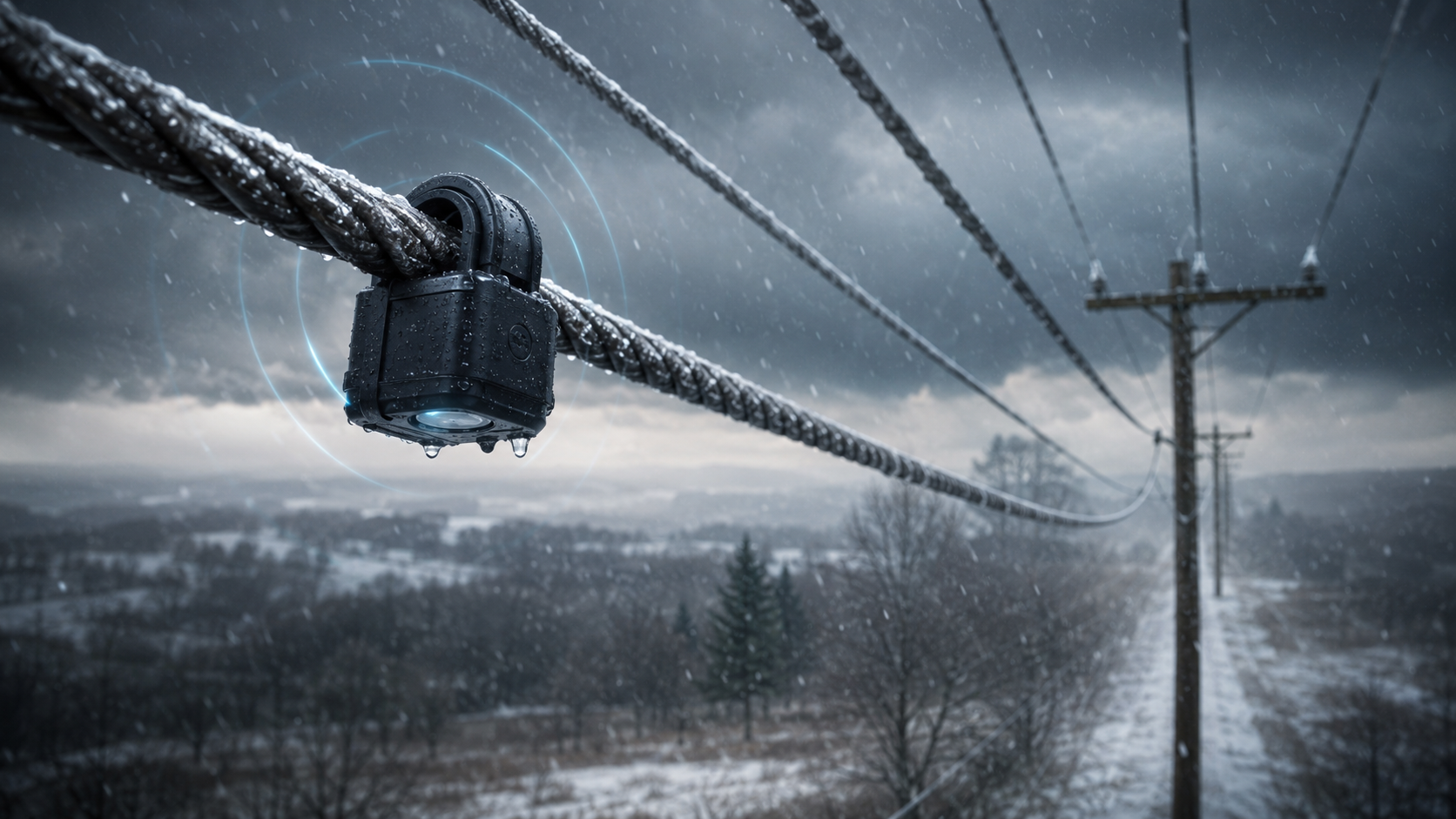
Harsh weather is one of the most difficult challenges for overhead power lines. Strong wind, lightning, ice, heavy rain, snow, salt fog, and falling branches can create faults, damage equipment, and make line inspection slower and more dangerous.
Overhead line monitoring helps utilities detect abnormal events faster and respond with better information. A line fault sensor or line fault indicator cannot stop a storm or repair a damaged conductor by itself. Its value is in showing where the problem is likely to be, so operators and field crews can act faster and with less uncertainty.
Quick Answer
Overhead line monitoring improves storm response by detecting fault passage, voltage loss, load changes, and line status at key points on a feeder. When this data is sent to a control center, operators can identify the likely faulted section, prioritize dispatch, reduce manual patrols, and restore healthy parts of the network sooner.
Weather Risks for Overhead Lines
Overhead lines are exposed to the environment. Unlike underground cables, they can be affected directly by wind, trees, lightning, ice loading, temperature changes, and contamination. This makes them easier to inspect visually, but also more vulnerable during severe weather.
Can move conductors, break branches, damage poles, or cause objects to contact the line.
Add mechanical load to conductors and nearby trees, increasing the risk of line contact or breakage.
Can cause transient faults, insulation stress, flashovers, and momentary outages.
Can worsen insulation problems and make access to faulted sections more difficult.
In many weather-related outages, the first problem is not only the fault itself. The larger operational challenge is knowing where the fault happened and how to reach it safely. That is why real-time overhead line monitoring becomes valuable.
What Overhead Line Monitoring Adds
Overhead line monitoring provides field information between the substation and the customer. This can include fault indication, load current, line status, voltage presence, or event alarms, depending on the monitoring system and device type.
Faster Fault Awareness
Operators can receive an indication that a fault passed through a specific point instead of waiting only for customer calls or patrol reports.
Better Search Area
When several devices are installed along a feeder, the suspected faulted section can be narrowed down more quickly.
Safer Crew Dispatch
Crews can be sent with clearer instructions, better location information, and more realistic access expectations.
Improved Restoration Planning
Control room teams can make better switching and isolation decisions when they have more field data.
Important: monitoring devices support decision-making, but they do not replace protection relays, circuit breakers, reclosers, or safe operating procedures. Their role is to improve visibility and response speed.
How Monitoring Changes Storm Response
During harsh weather, every minute matters. A traditional response often starts with a feeder trip, customer calls, and a wide patrol area. With monitoring, utilities can move to a more focused workflow.
Fault event occurs
A storm causes a short circuit, earth fault, conductor contact, or another abnormal condition on the overhead line.
Field devices detect the event
A line fault sensor or line fault indicator detects fault passage, current change, voltage loss, or another relevant signal.
Control center receives information
If remote communication is available, the event is sent to a monitoring platform, SCADA, outage management system, or distribution management system.
Operators narrow the faulted area
Data from several points helps identify the likely section between the last device that saw the fault and the next device that did not.
Crews are dispatched with better context
Repair teams receive more precise field information, which can reduce patrol time and help restore service faster.
What Data Matters in Harsh Weather?
Not every network needs the same level of monitoring. A remote rural feeder may need different data than an urban overhead section near automated switches. Still, several types of information are commonly useful during storms.
| Monitoring Data | Why It Matters | Operational Use |
|---|---|---|
| Fault passage indication | Shows whether fault current passed through a monitored point. | Helps locate the likely faulted section. |
| Voltage presence or loss | Helps confirm whether a line section is energized or de-energized. | Supports switching decisions and restoration checks. |
| Load current | Shows current flow and can reveal abnormal feeder loading. | Helps operators understand network condition before and after switching. |
| Event time stamp | Shows when the event occurred and helps compare data from several devices. | Supports event analysis and post-storm reporting. |
| Remote alarm status | Allows operators to receive information without waiting for field inspection. | Improves dispatch speed during difficult access conditions. |
Where Monitoring Is Most Useful
Monitoring devices provide the highest value where fault location is difficult, patrol time is long, or outages affect important customers. Placement strategy is just as important as the device itself.
High-value locations
- Long rural overhead feeders
- Branches through forest or mountain areas
- Sections with frequent storm-related faults
- Feeders supplying critical facilities
- Remote lines with difficult road access
Useful installation points
- Feeder branching points
- Before and after switching devices
- Boundaries between operating areas
- Sections with vegetation exposure
- Locations where patrol routes are long
A good placement plan helps operators interpret signals correctly. Random installation can create data, but planned installation creates useful operational visibility.
Selection Checklist for Harsh Weather Conditions
Devices used outdoors must be selected for the actual environment, not only for nominal voltage and current levels. Severe weather can expose weak points in communication, power supply, mounting, and event detection logic.
Check resistance to rain, snow, icing, dust, UV exposure, temperature extremes, and corrosion.
Confirm that the device can detect the expected fault types for the network grounding system.
Verify whether cellular, radio, or other communication works in the target area during normal and storm conditions.
Consider battery life, maintenance intervals, energy harvesting, and performance in low temperatures.
Make sure installation is suitable for the conductor, pole structure, safety practices, and local maintenance procedures.
Check whether the data can be used by SCADA, outage management, or distribution management workflows.
Practical Limits: What Monitoring Cannot Do
Overhead line monitoring is valuable, but it should not be oversold. A monitoring system improves awareness and response, but it does not remove all weather-related risks.
| Common Claim | More Accurate View |
|---|---|
| Monitoring prevents all outages. | Monitoring helps detect and locate faults faster, but storms can still damage lines and equipment. |
| A fault indicator replaces protection equipment. | A fault indicator supports fault location. Protection devices still interrupt fault current and protect equipment. |
| One device is enough for a long feeder. | Useful fault location usually requires planned placement at several key points. |
| Remote alerts remove the need for field crews. | Remote alerts improve dispatch, but crews are still needed for inspection, repair, and safe restoration. |
Operational Benefits During Severe Weather
When harsh weather affects several feeders at the same time, utilities must prioritize. Monitoring helps teams move from broad assumptions to better decisions based on field signals.
Reduced Patrol Time
Crews can inspect a narrower section instead of driving the full length of a feeder.
Better Priority Setting
Operators can focus first on faults that affect more customers or critical network sections.
Improved Safety
Field teams receive better information before entering areas affected by wind, ice, flooding, or fallen trees.
Clearer Communication
Dispatchers, operators, and customer service teams can work with more reliable information about the outage area.
FAQ
Can overhead line monitoring work during storms?
Yes, if the equipment, communication method, and installation are suitable for the environment. However, communication coverage and power supply should be checked carefully for remote locations and severe weather areas.
Is a line fault sensor the same as a protection relay?
No. A line fault sensor detects or reports line conditions. A protection relay is part of the protection system that makes trip decisions for breakers or other interrupting devices.
How does a line fault indicator reduce outage time?
It helps identify where the fault likely passed through the network. This reduces the search area and helps crews reach the damaged section faster.
Where should monitoring devices be installed?
They are most useful at feeder branches, remote sections, areas with frequent weather-related faults, and locations where patrols are long or difficult.
Conclusion
Harsh weather will always create risk for overhead power lines. Wind, lightning, ice, snow, rain, and vegetation can all lead to faults and difficult restoration conditions. The goal of overhead line monitoring is not to remove every risk, but to make the network more visible when the risk becomes real.
With the right placement and integration, a line fault sensor or line fault indicator can help utilities locate faults faster, reduce manual patrols, improve crew dispatch, and restore service more efficiently. For networks exposed to severe weather, that visibility can make the difference between a slow search and a focused response.
Use overhead line monitoring as part of a wider reliability strategy that includes protection coordination, vegetation management, field safety, communication planning, and post-event analysis.