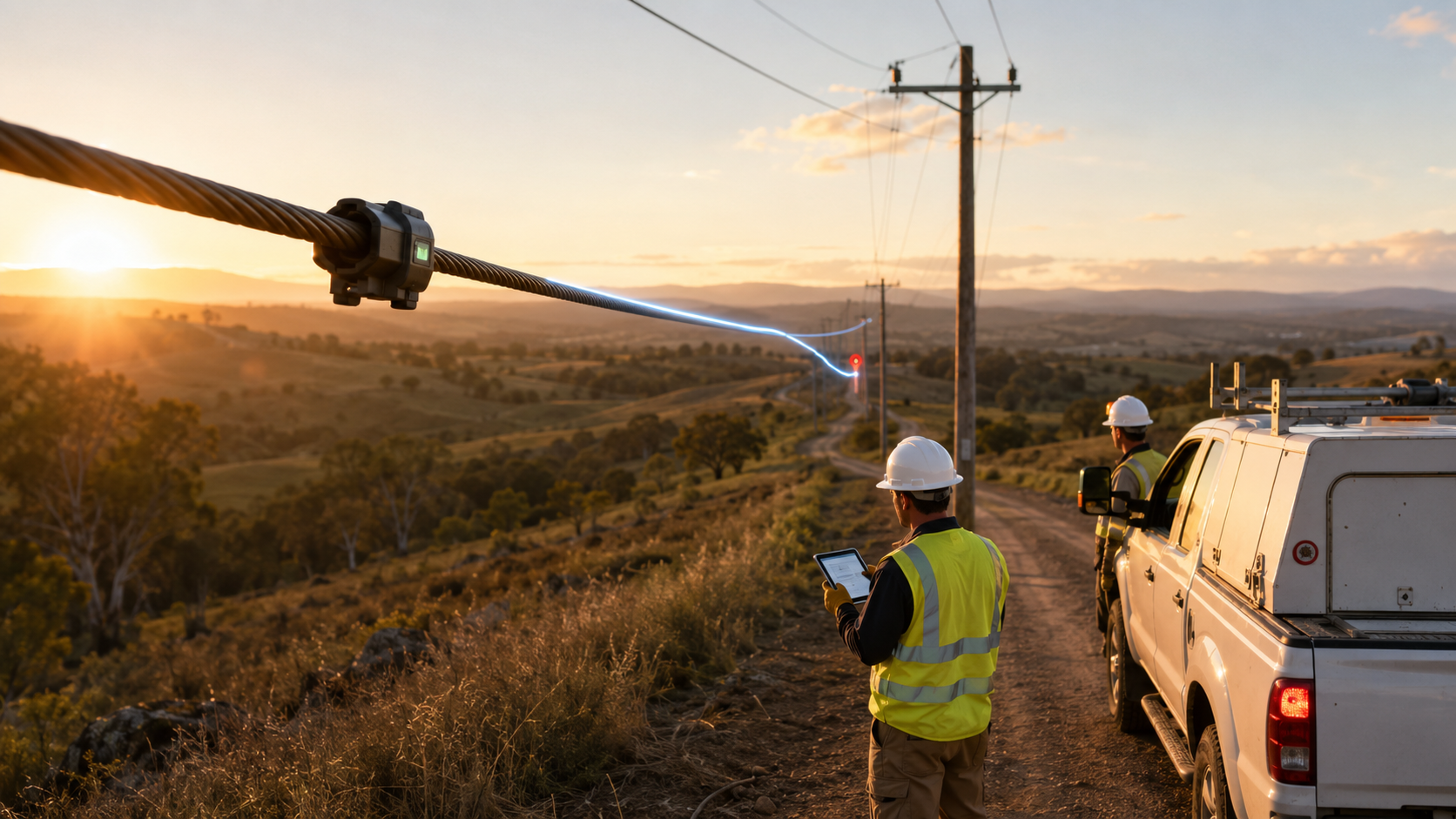
Manual line patrols are still a common part of outage response. When an overhead feeder trips, field crews may need to inspect long sections of line before they find the damaged span, failed component, fallen branch, broken insulator, or other fault source. This work is necessary, but it can be slow, costly, and difficult in remote areas.
Fault location devices, including overhead fault indicators, line fault sensors, and line fault indicators, help utilities reduce this search time. They provide clearer information about where a fault has passed, so dispatchers can narrow the patrol area and send crews closer to the likely problem location.
Quick answer
Fault location devices reduce manual line patrols by turning a wide-area search into a targeted inspection. Instead of checking an entire feeder, crews can focus on the section between the last device that detected the fault and the next device that did not.
Key benefits
- Shorter patrol routes
- Faster fault location
- Better crew dispatch
- Lower outage duration
Why manual line patrols take time
Overhead distribution lines often cover long distances and pass through areas with limited road access. In many cases, the control center knows that a feeder or section has tripped, but it does not immediately know the exact fault location.
Without field data, dispatchers may send crews to inspect the line from one known point to another. This can involve driving, walking, checking poles, looking for visible damage, and coordinating with switching teams. During storms or night operations, the same work becomes more difficult and less predictable.
Long feeders
A single outage may require inspection of many kilometers of overhead line before the damaged section is found.
Remote terrain
Forests, hills, rural roads, private land, and industrial sites can slow down physical access to the line.
Limited visibility
Some faults are easy to see, but others may involve equipment damage or vegetation contact that is not obvious from the road.
A typical outage scenario
A feeder trips during heavy wind. Customer calls confirm that several villages are without power, but the fault is not visible from the substation. The line crosses open fields and a wooded section. Without fault indicators, the crew may need to patrol the entire feeder section until they find the damaged point.
With fault location devices installed at key points, the operator can see which devices detected fault passage. If two upstream indicators operated and one downstream indicator did not, the likely faulted area becomes much smaller. The crew can be sent directly to that section instead of starting a full feeder patrol.
How fault location devices narrow the search area
The main value of a fault location device is not just detection. Its value is the operational information it provides. A line fault sensor or line fault indicator helps answer a simple question: did the fault current pass this point?
A fault occurs on the overhead line
The event may be caused by vegetation, lightning, conductor contact, equipment failure, wildlife, or external damage.
Protection equipment isolates the faulted circuit
Breakers, reclosers, fuses, or other protection devices operate according to the protection scheme. Fault indicators do not replace this protection equipment.
Fault indicators show where the fault current passed
Devices upstream of the fault may show a local visual indication or send a remote alert. Devices beyond the faulted section may remain normal.
The dispatcher narrows the patrol zone
The likely location is usually between the last operated indicator and the first non-operated indicator downstream, depending on network topology and installation points.
The crew is sent to the most relevant section
Instead of patrolling the whole line, the crew starts closer to the suspected fault. This can reduce drive time, inspection time, and restoration delay.
What data helps reduce patrols
A fault location device becomes more useful when its information is clear, timely, and easy to combine with the network map. For manual patrol reduction, operators usually need more than a simple alarm.
| Data point | Why it matters | How it helps crews |
|---|---|---|
| Device location | Shows where the indicator is installed on the feeder. | Helps dispatchers define the patrol start point. |
| Fault passage status | Shows whether the fault current passed the device. | Helps identify the likely section of the line. |
| Time of event | Confirms that the indication matches the actual outage event. | Reduces confusion during multiple or storm-related outages. |
| Reset status | Shows whether the device has returned to normal after restoration. | Supports post-restoration checks and event analysis. |
| Communication status | Confirms that remote data is available and up to date. | Prevents crews from relying on stale or missing information. |
Where to install fault location devices
Placement has a direct effect on how much manual patrol work can be reduced. If devices are installed only at a few points, they may confirm the affected feeder but not narrow the location enough. If they are installed strategically, they can divide the network into practical search zones.
Feeder branches
Installing devices near branch points helps identify whether the fault is on the main feeder or on a lateral.
Long rural sections
Devices can divide long lines into smaller patrol areas, which is useful when road access is limited.
Before difficult terrain
Indicators placed before and after forest, mountain, or remote sections can show whether crews need to enter that area.
Near switching points
Locations near switches, reclosers, and sectionalizing points can support faster isolation and restoration decisions.
Important limitation
Fault location devices do not remove the need for field inspection. They reduce the search area and improve dispatch decisions, but crews still need to verify the condition of the line, ensure safety, and repair the physical problem.
Manual patrol vs sensor-assisted response
The difference is mainly in how quickly the utility can move from uncertainty to action. A line fault indicator gives field and control teams a more focused starting point.
| Response stage | Traditional manual patrol | With fault location devices |
|---|---|---|
| Initial information | Feeder trip, customer calls, protection operation, possible SCADA alarms. | Feeder trip plus field indications from line fault sensors or indicators. |
| Search area | May include a long feeder section or several laterals. | Can often be narrowed to a smaller section between indication points. |
| Crew dispatch | Crew may begin from a substation, switching point, or broad suspected area. | Crew can be sent closer to the likely faulted segment. |
| Restoration planning | Depends heavily on field reports after patrol begins. | Can begin earlier with better information about the affected section. |
| Operational impact | More patrol time, higher uncertainty, longer restoration workflow. | Less search time, better coordination, faster decision-making. |
Integration with outage management and dispatch workflows
Fault location devices provide the highest value when their data is integrated into everyday utility operations. Local visual indication is useful for crews, but remote indication can support faster control room decisions before a crew reaches the site.
When fault data is connected to SCADA, an outage management system, a distribution management system, or a GIS-based network map, operators can combine device status with feeder topology, customer calls, switching devices, and crew location. This makes the response more coordinated and less dependent on guesswork.
SCADA
Supports real-time visibility and allows operators to see fault-related events from the control center.
OMS
Helps manage outages, prioritize restoration work, and coordinate field crews.
DMS
Supports network analysis, switching decisions, and service restoration planning.
Implementation checklist
To reduce manual line patrols effectively, utilities should plan both the device installation and the operating process around real field needs.
- Map the feeders where outage search time is consistently high.
- Identify long line sections, remote areas, and critical branches.
- Choose device locations that divide the network into useful patrol zones.
- Define how local and remote indications will be used by dispatchers.
- Connect remote alerts to SCADA, OMS, DMS, or another operational platform where practical.
- Train crews to interpret line fault indicator status correctly.
- Review event records after outages to improve device placement and response procedures.
Common mistakes to avoid
A fault location project should be practical. The goal is not simply to install more equipment, but to make outage response faster and more precise.
| Mistake | Why it creates problems | Better approach |
|---|---|---|
| Installing devices without a feeder plan | Indicators may not divide the network into useful search zones. | Plan placement around branches, switching points, and difficult patrol areas. |
| Using alarms without location context | Dispatchers may receive data but still not know where to send crews. | Link device data to a feeder map or operational system. |
| Ignoring communication reliability | Remote indication may be delayed or unavailable during bad weather. | Check coverage, backup procedures, and local indication options. |
| Expecting devices to replace inspection | The faulted section still needs safety checks and repair. | Use devices to guide patrols, not eliminate field verification. |
FAQ
Can fault location devices completely eliminate manual patrols?
No. They can significantly reduce the search area, but crews still need to inspect the line, confirm the fault condition, isolate hazards, and complete repairs.
What is the difference between a line fault sensor and a line fault indicator?
The terms are often used closely in distribution network discussions. A line fault indicator usually focuses on showing that a fault has passed a point. A line fault sensor may also provide measured data or remote monitoring functions, depending on the system design.
Are fault indicators only useful on rural lines?
No. They are especially valuable on long rural feeders, but they can also help on industrial feeders, overhead laterals, difficult-access areas, and networks where fast restoration is important.
Do fault location devices replace protection relays or reclosers?
No. Protection devices detect and interrupt fault current according to the protection scheme. Fault location devices provide additional information that helps operators and crews locate the affected section faster.
Conclusion
Manual line patrols will remain part of overhead line maintenance and outage response. However, they do not need to start with a wide-area search every time a feeder trips.
Fault location devices, including line fault sensors and line fault indicators, help utilities narrow the search area, dispatch crews more accurately, and reduce the time spent looking for faults. When combined with good device placement, clear operating procedures, and integration with SCADA, OMS, or DMS platforms, they become a practical tool for faster and more efficient outage response.
The result is not only less patrol work. It is better information, faster decisions, and a more reliable distribution network.
Need a better way to locate overhead line faults?
Explore modern approaches to overhead line fault indication, remote monitoring, and faster crew dispatch for distribution networks.
Learn more about overhead line fault indicators and sensors