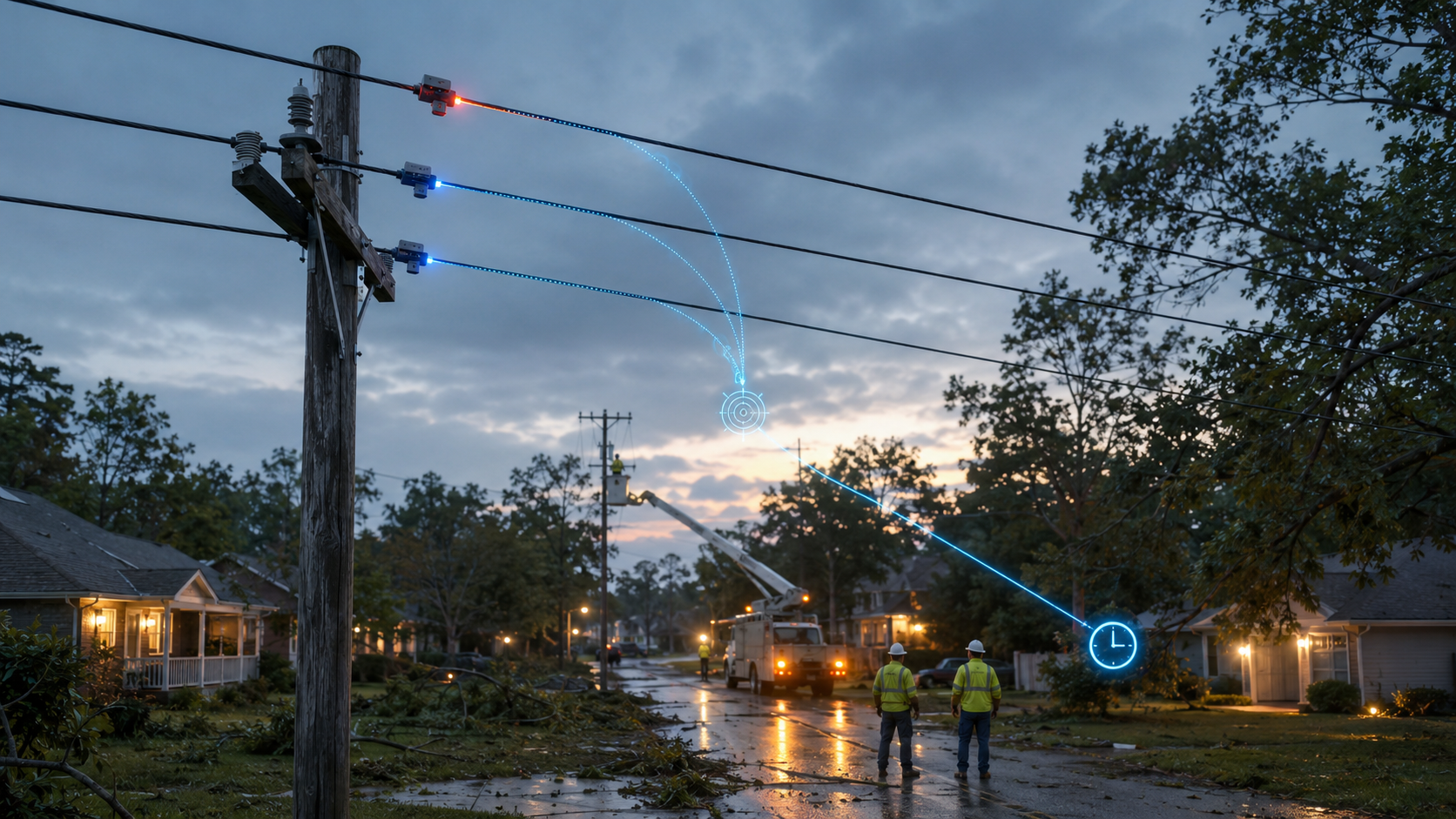
Overhead distribution lines are exposed to wind, lightning, vegetation, wildlife, ice, and mechanical damage. When a fault occurs, the fastest restoration is not only about sending a crew quickly. It is about sending the right crew to the right section of the line with enough information to act safely.
Overhead line fault indicators help utilities do exactly that. A fault indicator, line fault sensor, or line fault indicator provides local or remote information that a fault has passed through a specific point on the network. This makes it easier to narrow the search area, reduce manual line patrols, and restore power faster.
Quick answer
Overhead line fault indicators reduce outage time by showing which part of a feeder is likely faulted. Instead of inspecting the entire line, operators and field crews can focus on the section between the last triggered indicator and the next non-triggered point. When remote communication is available, this information can also support faster dispatch, better switching decisions, and more accurate outage management.
Why outages on overhead lines can take time
When a protection device trips, the control center usually knows that a feeder or line section is out of service. What may be unclear is the exact location of the problem. The fault may be caused by a fallen branch, a damaged insulator, a conductor contact, lightning, a pole-top equipment failure, or another local event.
Without enough field data, crews often need to patrol long sections of overhead line. This can take a long time when the route crosses private land, forests, hills, snow-covered roads, or areas with limited access. The restoration clock keeps running while crews search for the faulted section.
Fault indicators help reduce the time spent finding the likely faulted section.
More precise location data helps crews start from the right part of the feeder.
Operators can make better switching and isolation decisions when field signals are available.
For utilities, this matters because outage duration directly affects customer experience, operational cost, and reliability performance. A fault indicator cannot remove the cause of a fault, but it can shorten the time between the fault event and the start of targeted repair work.
Where overhead line fault indicators reduce outage time
Outage time is not a single activity. It is a chain of operational steps. Fault indicators can improve several parts of that chain by replacing uncertainty with actionable location information.
| Outage stage | Without fault indication | With overhead line fault indicators |
|---|---|---|
| Fault awareness | Operators may rely on protection trips, customer calls, and delayed field reports. | A local or remote indication can confirm that a fault has passed a specific point. |
| Fault location | Crews may patrol a long feeder or several branches before finding the damaged area. | Triggered and non-triggered indicators help narrow the likely faulted section. |
| Crew dispatch | Dispatchers may send crews to a broad area with limited location detail. | Crews can be routed closer to the suspected fault location. |
| Switching decisions | Operators may need more confirmation before isolating and restoring healthy sections. | Field data supports safer and faster decisions, especially when combined with SCADA, OMS, or DMS. |
| Customer updates | Estimated restoration time may be uncertain during the search phase. | More accurate fault location can support clearer internal and customer communication. |
A typical restoration workflow with fault indicators
The exact process depends on the utility, network design, communication system, and operating rules. In general, overhead line fault indicators support a more focused restoration workflow.
1. A fault occurs on an overhead feeder
The fault may be phase-to-phase, phase-to-ground, temporary, or permanent. Protection equipment such as breakers, fuses, or reclosers operates according to the protection scheme.
2. The fault indicator detects a fault passage
A line fault sensor or line fault indicator detects abnormal electrical conditions and changes state. Depending on the device and configuration, it may show a visual signal, send a remote alert, or both.
3. Operators identify the likely faulted section
If several indicators are installed along a feeder, the faulted area can often be narrowed down by comparing which indicators operated and which did not.
4. Crews are dispatched more precisely
Instead of starting at the substation or patrolling the entire feeder, crews can inspect the most relevant section first. This reduces travel time and unnecessary inspection.
5. Healthy sections can be restored sooner
When the faulted section is understood, operators may be able to isolate it and restore unaffected sections according to approved switching procedures.
Key point
The main value of overhead line fault indicators is not that they repair the network. Their value is that they help shorten the investigation phase, which is often one of the most time-consuming parts of outage response.
Local indication vs remote fault indication
Fault indicators can be useful in both simple and advanced distribution networks. The difference is how the information reaches the people who need it.
Local visual indication
A visual indicator, such as an LED or mechanical target, helps crews confirm that a fault has passed through a particular point on the overhead line.
- Useful during field inspection
- Simple to understand on site
- Helpful where communication coverage is limited
- Still requires crew presence to observe the signal
Remote indication
A remotely monitored fault indicator sends event data to the utility through radio, cellular, or another communication channel.
- Supports faster control center awareness
- Helps dispatchers plan before crews arrive
- Can be integrated with SCADA, OMS, or DMS
- Depends on communication coverage and data quality
For reducing outage time, remote indication usually provides the greatest operational benefit because the control center receives fault information earlier. Local indication remains valuable because it helps crews verify the condition directly in the field.
Where fault indicators are most effective
Placement has a major effect on how much time a utility can save. Installing indicators randomly may add data, but strategic placement creates useful visibility.
Long rural feeders
Fault indicators reduce the need to patrol many kilometers of line before finding the suspected faulted section.
Branching points
Indicators near laterals and taps help determine whether the fault is on the main feeder or a branch line.
Hard-to-access areas
Remote fault data is especially useful where terrain, weather, or road conditions slow down inspection.
Critical customers
Line visibility near important loads can support faster response and clearer restoration planning.
Good placement usually follows the structure of the feeder. Utilities often focus on main feeder routes, major branches, normally open points, switching locations, and sections with frequent faults.
How system integration improves the result
A standalone indicator can still help. But the value increases when fault data becomes part of the wider utility workflow.
| System | How it uses fault indicator data | Operational benefit |
|---|---|---|
| SCADA | Displays field status and fault events for operators. | Improves situational awareness and supports faster operational decisions. |
| OMS | Combines outage calls, meter data, switching status, and field indications. | Improves outage location, crew dispatch, and restoration estimates. |
| DMS | Uses network models and real-time data for switching and restoration analysis. | Supports fault isolation and service restoration planning. |
| Mobile workforce tools | Shares fault location information with crews in the field. | Helps crews inspect the right section first and report status faster. |
This is why the phrase line fault sensor is often used together with terms such as distribution automation, outage management, feeder monitoring, remote fault indication, and smart grid visibility. The sensor is useful not only because it detects an event, but because that event can be turned into an operational decision.
What fault indicators cannot do
Fault indicators are helpful, but they should not be described as a complete outage solution. They support fault detection and location; they do not replace protection equipment, switching devices, or field repair.
Important limitations to understand
- A fault indicator does not prevent storms, vegetation contact, lightning, or equipment failure.
- A line fault indicator does not repair a damaged conductor, insulator, pole, or transformer.
- Incorrect settings may cause missed events or false indications.
- Remote devices depend on communication availability and correct system integration.
- Fault location still requires proper operating procedures and trained personnel.
The realistic claim is clear: overhead line fault indicators help utilities reduce the time needed to find and manage faults. The final restoration still depends on network design, protection coordination, switching options, crew availability, weather, access conditions, and repair complexity.
Practical checklist for reducing outage time
To get real operational value from fault indicators, utilities should treat them as part of a reliability and outage response process, not as isolated hardware.
Map the slowest feeders
Start with feeders where patrol time, outage duration, or access difficulty creates the largest operational impact.
Define useful fault sections
Place indicators so crews can quickly understand which section, branch, or lateral is most likely affected.
Set clear response rules
Dispatchers and crews should know how to interpret triggered and non-triggered indicators during an outage.
Connect data to systems
Remote indication becomes more valuable when it feeds SCADA, OMS, DMS, or workforce management tools.
FAQ
Do overhead line fault indicators reduce every outage?
No. They are most useful when outage time is affected by fault search, line patrol, and dispatch uncertainty. They cannot prevent all faults or repair physical damage.
Is a fault indicator the same as a protection relay?
No. Protection relays and protective devices operate to clear faults according to the protection scheme. Fault indicators provide indication and location support. They help operators and crews understand where the fault may have occurred.
What is the difference between a line fault sensor and a line fault indicator?
The terms are often used in closely related contexts. A line fault sensor emphasizes the sensing function, while a line fault indicator emphasizes the visible or remote indication of a detected fault. In many practical discussions, the terms overlap.
Are remote fault indicators better than visual indicators?
Remote indicators usually provide faster control center awareness, while visual indicators are useful for crews in the field. Many utilities use both functions depending on the feeder and operating process.
Conclusion
Overhead line fault indicators reduce outage time by helping utilities find the likely faulted section faster. They improve visibility on overhead feeders, reduce unnecessary patrols, support better crew dispatch, and provide useful data for outage management and distribution automation.
The most effective use of fault indicators combines three elements: strategic placement, correct settings, and integration with utility workflows. When these elements are in place, a fault indicator becomes more than a device on a line. It becomes a practical tool for faster restoration and better service reliability.
Need better visibility on overhead distribution lines? Explore modern overhead line fault indicators and sensors for fault detection, remote indication, and faster outage response.