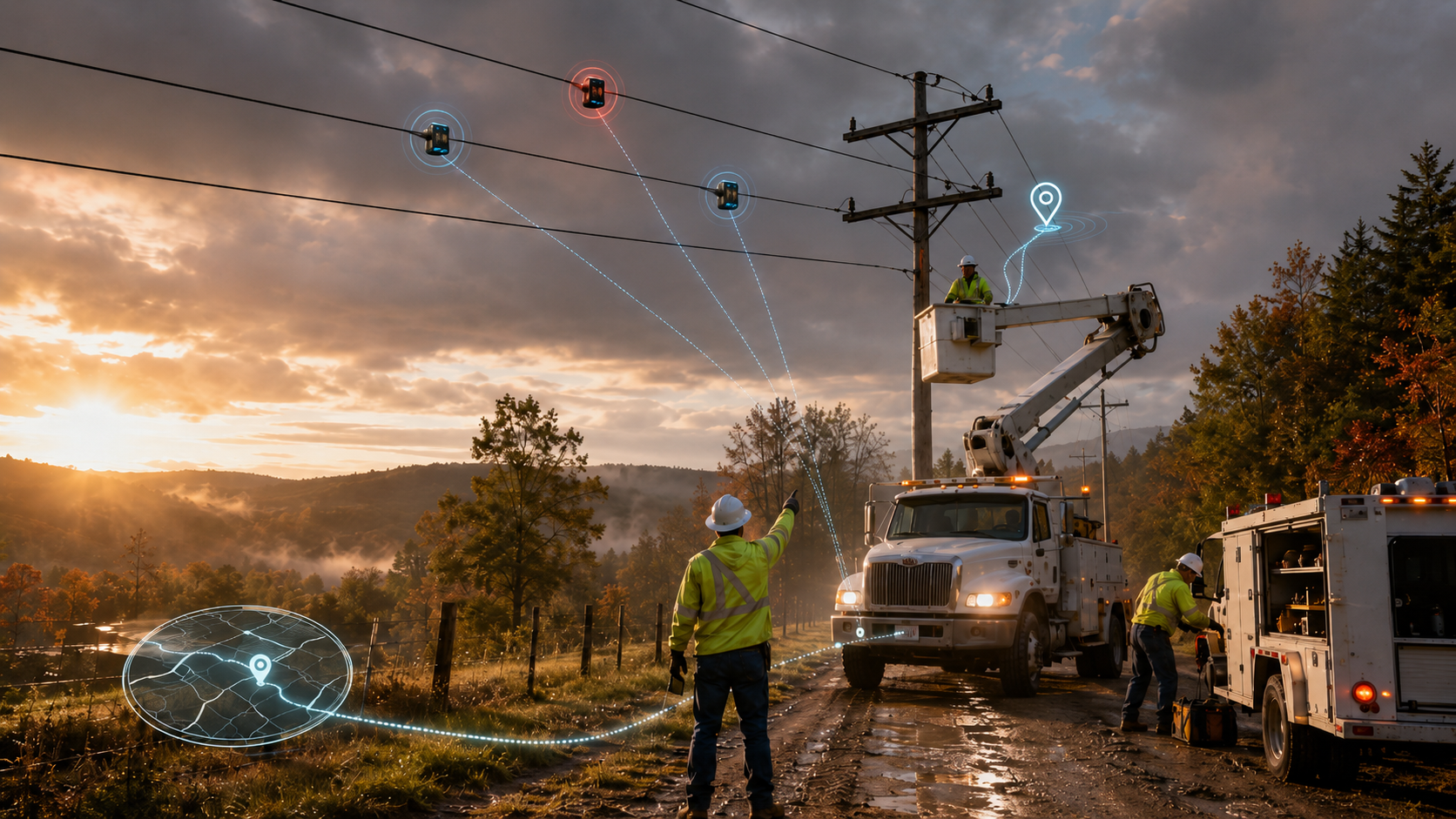
When a distribution line trips, the first challenge is not always the repair itself. Very often, the most time-consuming part is finding the faulted section. Crews may need to inspect long overhead feeders, check branches, drive through remote roads, and confirm whether the problem is a temporary fault or a permanent failure.
Fault indicators help utilities shorten this process. They show whether fault current has passed through a specific point on the line and, in many systems, send this information remotely to the control center. This makes crew dispatch faster, more accurate, and easier to coordinate.
Key Point
Fault indicators do not repair the line and do not prevent every outage. Their main value is faster fault location, better outage information, and more focused crew dispatch.
Why Crew Dispatch Can Be Slow Without Fault Data
In a traditional outage response process, the control center may know that a feeder has tripped, but not the exact location of the fault. Customer calls, protection relay data, and substation alarms can confirm that an interruption has occurred, but they may not show which section of the line needs inspection first.
This creates uncertainty. A dispatcher may send a crew to patrol a wide area. The crew may need to check several kilometers of line, inspect branch lines, verify switching points, and look for visible signs of damage such as fallen trees, broken insulators, conductor contact, animal contact, or damaged equipment.
On long overhead distribution lines, this can take hours. Bad weather, difficult terrain, night work, or limited road access can make the search even slower. Every extra minute increases outage duration and delays restoration for customers.
The operational problem
Without reliable field data, dispatch decisions are often based on incomplete information. Crews may be sent too far downstream, too close to the substation, or to a branch that did not experience the fault. This does not mean the dispatch process is wrong; it means the network is not visible enough.
What Fault Indicators Do
A fault indicator, also called a faulted circuit indicator or fault passage indicator, is a device used in power distribution networks to detect and indicate fault events. On overhead lines, these devices are typically installed at selected points along the feeder or on important branches.
When a short circuit or earth fault occurs, the fault indicator detects abnormal electrical conditions. Depending on the design, it may use current sensing, voltage sensing, or a combination of measurements. The device then provides a local visual signal or sends a remote notification.
Local Indication
Field crews can see a visual signal on site and confirm that a fault passed through a specific location.
Remote Alerts
Operators can receive fault information through communication channels before the crew arrives.
Fault Section Clues
Data from several indicators helps narrow the suspected section of the feeder.
The result is not an exact repair instruction, but a much clearer starting point. Instead of inspecting the entire feeder, the utility can focus on the part of the network where the fault is most likely located.
How Fault Indicators Improve the Dispatch Workflow
Faster crew dispatch begins with better information. When fault indicators are installed at strategic locations, they help the dispatcher move from a broad outage area to a more specific inspection zone.
1. Faster fault confirmation
After a feeder trip, fault indicators can confirm whether the event passed through a monitored point. This helps operators understand whether the suspected section is upstream or downstream from that location.
2. Narrower search area
If one indicator shows fault passage and the next downstream indicator does not, the likely faulted section is between those two points. This gives crews a more focused route and reduces unnecessary patrol time.
3. Better crew routing
Dispatchers can send crews closer to the suspected fault location. This is especially important when several roads, branches, or access points are available. Better routing helps reduce travel time and improves the chance that the first crew reaches the right area.
4. More efficient resource allocation
During storms or large outage events, utilities may have many incidents at the same time. Fault indicator data helps dispatchers prioritize work, assign crews more effectively, and avoid sending multiple teams to inspect the same non-faulted area.
5. Faster restoration planning
Once the likely faulted section is known, operators can plan switching more confidently. In networks with remote-controlled switches, reclosers, or distribution automation systems, this data can support faster isolation of the damaged section and restoration of healthy sections.
Remote Fault Indication and Control Centers
Local visual indication is useful, but remote fault indication creates a stronger impact on dispatch speed. If the fault information is sent to the control center, dispatchers can start evaluating the event immediately.
Remote fault indicators may be integrated with SCADA, an outage management system, or a distribution management system. This allows operators to combine field device data with feeder maps, switching status, customer outage reports, and restoration plans.
| Dispatch Stage | Without Fault Indicators | With Fault Indicators |
|---|---|---|
| Fault awareness | Based mainly on feeder trip alarms and customer calls | Supported by line-level fault passage data |
| Search area | May include a long feeder or several branches | Can be narrowed to a likely faulted section |
| Crew routing | Crews may start from a broad inspection point | Crews can be directed closer to the suspected location |
| Restoration planning | More dependent on field reports after inspection | Can begin earlier with better situational awareness |
Remote indication does not remove the need for field verification. A crew still needs to inspect the line, make the area safe, and repair the damaged equipment. However, the crew can begin with better information and a clearer route.
Where Fault Indicators Are Most Useful
Fault indicators can support faster crew dispatch in many distribution networks, but their value is especially clear where fault location is difficult or expensive.
- Long overhead feeders: A small reduction in patrol distance can save significant time.
- Rural distribution lines: Remote areas often have fewer access roads and longer travel times.
- Forest and storm-prone areas: Vegetation, wind, lightning, and weather-related faults can create frequent outages.
- Industrial supply feeders: Faster restoration can reduce downtime for critical facilities.
- Branch-heavy networks: Indicators can help identify which branch is likely affected.
- Networks with automation: Fault data can support SCADA, OMS, DMS, and FLISR workflows.
Practical Placement
Fault indicators are often most useful at feeder branches, long line sections, switching points, and areas where patrol time is high. Placement should be based on network topology, outage history, access conditions, and operational priorities.
Impact on Outage Duration and Reliability
Fault indicators mainly affect the time between the outage event and the start of effective repair or switching action. By reducing the time needed to locate the faulted section, they can help reduce overall outage duration.
This is important for reliability indicators such as SAIDI and CAIDI, which are connected with interruption duration and restoration time. Fault indicators should not be described as a universal solution for all reliability problems. Their role is more specific: they improve visibility and help crews reach the right area faster.
For utilities, the operational benefits can include fewer unnecessary truck rolls, shorter patrol routes, better use of field teams, and more accurate restoration communication. For customers, the benefit is simpler: power can be restored sooner when the fault is found faster.
What Utilities Should Consider
To support faster crew dispatch, fault indicators must match the network and the utility’s operating process. The wrong settings, poor placement, or weak communication coverage can reduce the value of the system.
Key selection factors
- voltage level and network configuration;
- expected short-circuit and earth fault current levels;
- overhead or underground installation conditions;
- need for visual indication, remote alerts, or both;
- communication options and signal coverage;
- compatibility with SCADA, OMS, or DMS platforms;
- environmental conditions such as temperature, rain, wind, snow, dust, and icing;
- reset logic after temporary faults and re-energization;
- maintenance requirements and expected service life.
It is also important to define how the data will be used. A fault indicator is most valuable when its signal becomes part of a clear dispatch procedure: who receives the alert, how the suspected section is identified, how crews are routed, and how field feedback is recorded.
Common Mistakes to Avoid
Fault indicators can improve dispatch speed, but they need proper planning. Utilities should avoid treating them as simple standalone devices without considering the full outage response workflow.
- Installing indicators without a placement strategy: Random placement may not reduce patrol time.
- Ignoring communication coverage: Remote indication depends on reliable data transfer.
- Using unsuitable settings: Incorrect thresholds can cause missed operations or false indications.
- Not training dispatchers: Control center staff must understand how to interpret the signals.
- Skipping field validation: Indicator data should guide the crew, not replace safe inspection and verification.
Conclusion
Fault indicators support faster crew dispatch by giving utilities better information about where a fault has passed and which section of the network should be inspected first. This helps reduce manual line patrols, improve crew routing, and support faster service restoration.
Their value is strongest on long overhead feeders, rural lines, hard-to-access areas, and automated distribution networks. When integrated with SCADA, outage management, or distribution management systems, fault indicators become part of a more efficient outage response process.
For modern distribution utilities, faster dispatch is not only about sending crews quickly. It is about sending the right crew to the right place with the right information. Fault indicators help make that possible.
Operational takeaway: Fault indicators provide the greatest value when they are planned together with dispatch procedures, crew routing, and outage restoration workflows.