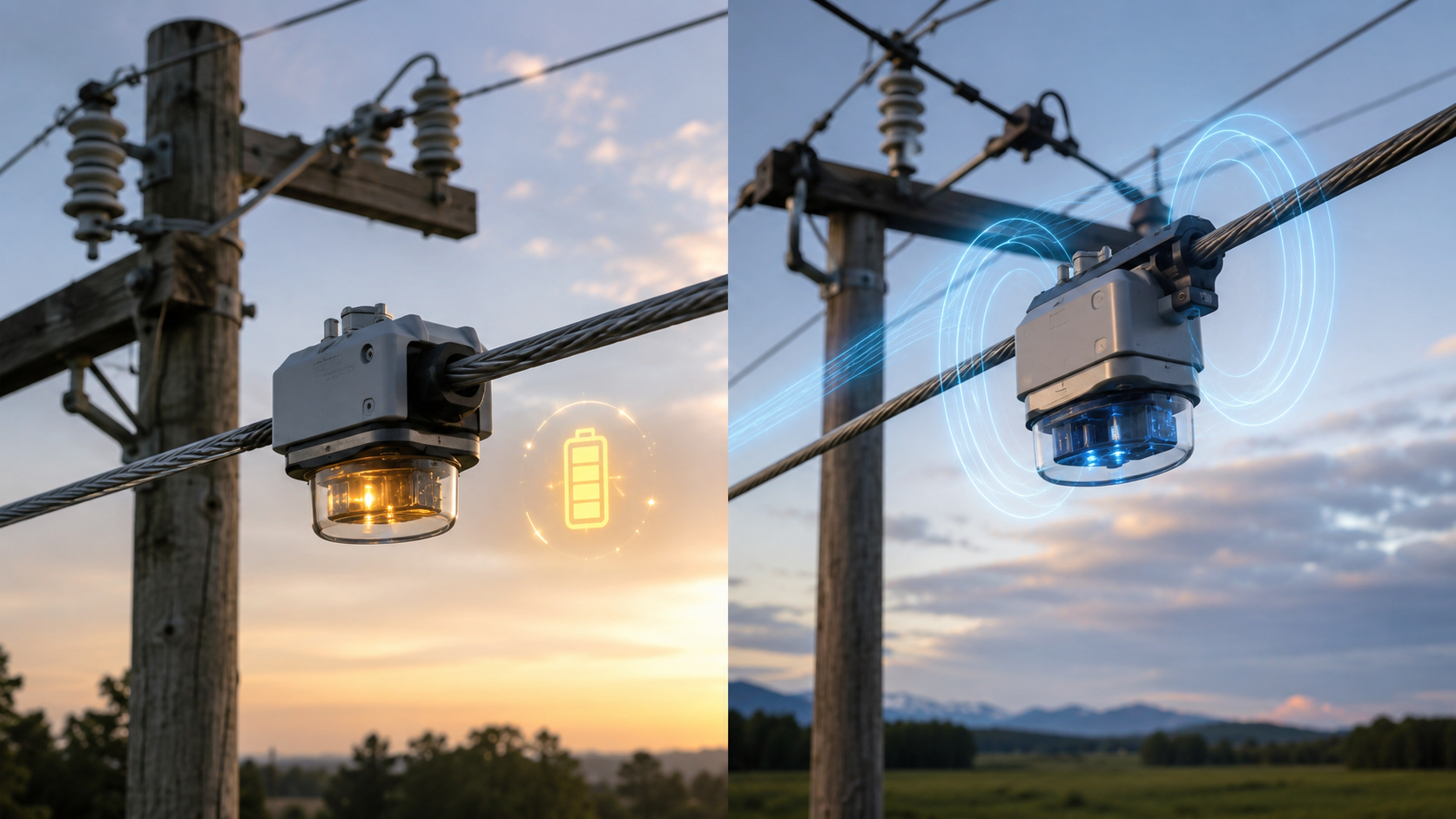
Fault indicators help utilities detect and locate faults on overhead distribution lines. The power source behind the device may seem like a small detail, but it affects maintenance planning, communication reliability, installation strategy, and long-term operating cost.
Battery-powered fault indicators
Best suited for applications where the device must remain ready even when line current is low, intermittent, or not suitable for energy harvesting. The trade-off is battery life planning and periodic replacement.
Self-powered fault indicators
Best suited for feeders where the device can harvest enough energy from the line or surrounding electric and magnetic fields. The trade-off is that performance depends on the actual operating conditions and device design.
Quick takeaway
Neither option is universally better. A battery-powered line fault indicator is often simpler to specify for low-load or remote points. A self-powered line fault sensor can reduce battery maintenance, but it should be matched carefully to feeder load, voltage conditions, communication needs, and climate.
What the Power Source Changes
An overhead line fault indicator detects abnormal electrical conditions and gives a local or remote signal when a fault passes through a monitored point. The device may use current sensing, voltage-related sensing, directional logic, wireless communication, LED indication, or integration with SCADA and outage management workflows.
The power source does not change the basic goal: faster fault detection and faster fault location. However, it changes how the device behaves in the field and how the utility maintains it over time.
Availability
Will the device remain ready during low-load periods, outages, cold weather, and long idle periods?
Maintenance
Will crews need to replace batteries, inspect energy storage components, or verify charging performance?
Communication load
Remote fault indication, cellular reporting, radio communication, and frequent status messages require more energy than simple visual indication.
Network conditions
Feeder load, voltage presence, conductor type, and installation point can affect whether self-powered operation is practical.
Battery-Powered Fault Indicators
A battery-powered fault indicator uses an internal battery to support sensing electronics, local indication, memory, communication, or a combination of these functions. This makes it less dependent on the immediate load current of the line.
When battery power is useful
Battery-powered devices are often selected for overhead feeders with variable load, seasonal demand, low current, or locations where the monitoring point may not provide enough energy for harvesting. They can also be useful where the utility wants predictable readiness across different operating states.
For a line fault sensor with remote communication, battery capacity must be planned carefully. Transmitting frequent data, sending event reports, operating in cold weather, or maintaining standby communication can all increase energy use.
Typical strengths
- Less dependent on minimum line current
- Suitable for low-load and intermittent-load feeders
- Simple to understand from a maintenance planning perspective
- Useful for visual and remote fault indication
Important limitation
A battery-powered line fault indicator still needs lifecycle management. Battery aging, temperature exposure, communication frequency, and storage time before installation can all affect service life.
Self-Powered Fault Indicators
A self-powered fault indicator uses energy available around the energized line. Depending on the design, it may harvest energy from the magnetic field created by current flow, from the electric field around the conductor, or from another line-related source. Some systems may also include internal energy storage for backup or short-term operation.
The main advantage is reduced dependence on scheduled battery replacement. For large networks with many installed devices, this can be attractive because battery maintenance can become expensive and time-consuming.
Harvest
The device collects available energy from the line environment.
Store
Energy may be stored in a capacitor, rechargeable cell, or another internal storage element.
Operate
The device uses that energy for sensing, indication, communication, or wake-up events.
Practical note
Self-powered does not always mean “works under every condition without limits.” The device must receive enough usable energy for the required functions. This is why feeder load, voltage class, communication interval, and installation point should be checked before deployment.
Battery-Powered vs Self-Powered: Side-by-Side Comparison
The right choice depends on how the device will be used. A simple visual fault indicator has different power needs than a remotely monitored device that sends alarms, status updates, and diagnostic data.
| Criterion | Battery-Powered Fault Indicator | Self-Powered Fault Indicator |
|---|---|---|
| Power source | Internal battery supplies device electronics and indication functions. | Energy is harvested from the line environment, depending on design and conditions. |
| Best fit | Low-load feeders, remote points, seasonal loads, and applications needing predictable standby power. | Feeders with suitable load or voltage conditions and a goal to reduce battery maintenance. |
| Maintenance | Battery inspection or replacement must be planned. | Battery replacement may be reduced, but energy harvesting and storage performance should be verified. |
| Communication | Remote reporting is possible, but communication frequency affects battery life. | Remote reporting is possible if harvested energy and storage are sufficient. |
| Low-load operation | Usually easier to support because operation does not rely mainly on load current. | May be limited if available line energy is too low, depending on the technology. |
| Long-term cost | Lower complexity may be offset by field visits for battery service. | Higher selection requirements may be offset by less battery-related maintenance. |
Where Each Option Fits Best
Utilities should choose the power approach based on feeder behavior, not on a general preference. The same network may use both types in different locations.
Rural feeders
Battery-powered options may be practical when load varies heavily and access is difficult. Self-powered options can also work if the line conditions support reliable energy harvesting.
Urban and industrial feeders
Self-powered devices may be attractive where load is stable and maintenance reduction is a priority.
Remote fault indication
Both options can support remote alarms, but communication strategy must match the available energy budget.
Critical branches
A battery-powered or hybrid approach may be preferred when readiness is more important than minimizing battery maintenance.
| Network Situation | Usually Better Starting Point | Why |
|---|---|---|
| Very low or seasonal load | Battery-powered or hybrid | Energy harvesting may not be consistent enough for all functions. |
| Stable feeder load | Self-powered | The line may provide a more consistent energy source. |
| Frequent remote status reports | Depends on energy budget | Communication can be one of the largest energy demands. |
| Difficult access for maintenance | Self-powered or long-life battery | The goal is to reduce field visits while keeping reliable operation. |
Selection Checklist for Utilities
Before selecting a battery-powered or self-powered line fault indicator, review the following practical points. This keeps the decision focused on field performance rather than device labels.
- Check feeder load profile. Review minimum load, peak load, seasonal changes, and long low-load periods.
- Define the function. Decide whether the device needs only local LED indication or full remote fault reporting.
- Estimate the communication energy demand. Cellular, radio, and frequent status updates can change the power requirement significantly.
- Consider weather and temperature. Cold and heat can affect batteries, electronics, and energy storage components.
- Plan maintenance intervals. A lower purchase cost may not be the lowest lifecycle cost if it requires frequent field visits.
- Confirm integration requirements. If data must go to SCADA, OMS, or DMS, confirm that the power source supports the needed reporting behavior.
Common Mistakes to Avoid
Choosing only by battery life
Battery life is important, but it should be evaluated together with communication frequency, alarm logic, reset behavior, climate, and maintenance access.
Assuming self-powered means maintenance-free
Self-powered devices can reduce battery-related work, but they still need proper installation, periodic checks, and verification that line conditions provide enough energy.
Ignoring low-load operation
A self-powered line fault sensor should be checked against the lowest expected load, not only the average feeder load.
Overlooking false indication risks
Fault indicators should distinguish real faults from normal switching, inrush current, temporary events, or load changes as far as the application requires.
How Power Source Affects Fault Detection Strategy
In overhead line monitoring, a fault indicator is not just a standalone device. It supports a larger operational process: fault detection, section identification, crew dispatch, restoration planning, and post-event review.
If the goal is simple field visibility, a local line fault indicator may be enough. If the goal is automated outage response, utilities may need remote fault indication, event logs, communication with a control center, and integration with outage management systems. In that case, the energy budget becomes a central design point.
Balanced recommendation
Use battery-powered fault indicators where predictable standby operation is critical. Use self-powered fault indicators where line conditions support reliable energy harvesting and where reducing battery maintenance is a priority. For demanding sites, consider hybrid approaches if available.
FAQ
Is a self-powered fault indicator always better than a battery-powered one?
No. Self-powered designs can reduce battery maintenance, but they must have enough usable energy from the line. Battery-powered designs may be more suitable for low-load or intermittent-load feeders.
Can a battery-powered line fault sensor support remote alerts?
Yes, but the battery must be sized for the expected reporting behavior. Frequent communication, cold weather, and long standby periods can reduce effective service life.
Do fault indicators replace protection relays or reclosers?
No. Fault indicators help detect, indicate, and locate faults. Protection devices such as relays, breakers, and reclosers are responsible for interrupting fault current and protecting the network.
Which option is better for remote overhead lines?
It depends on access, load profile, communication requirements, and climate. Remote sites often benefit from long maintenance intervals, but the power source must remain reliable under the lowest expected operating conditions.
Conclusion
Battery-powered and self-powered fault indicators both support faster fault detection and better overhead line visibility. The difference is not in the basic purpose of the device, but in how it stays operational in the field.
Battery-powered devices offer predictable energy availability, especially in low-load or intermittent-load conditions, but require battery lifecycle management. Self-powered devices can reduce battery maintenance by harvesting energy from the line environment, but they must be matched carefully to actual feeder conditions.
The best choice is the one that fits the network: load profile, access conditions, communication requirements, climate, and maintenance strategy. When selected correctly, a line fault sensor or line fault indicator can help utilities locate faults faster, reduce manual inspection, and improve outage response.
To learn more about practical options for overhead line monitoring, explore overhead line fault indicators and sensors.